

What Are the Black Dots in Plantar Warts? Treatment in Brentwood, CA
The tiny black dots in a plantar wart aren’t actually “seeds”—they are small, clotted blood vessels feeding the viral infection. Because the pressure of walking pushes these warts deep into the sole of your foot, they can become highly painful and resistant to home remedies. At Bay Area Foot and Ankle Associates in Brentwood, CA, Dr. John W. Scivally, DPM, and Dr. Robin K. Lie, DPM, provide professional podiatry treatments to safely eradicate these stubborn viral growths and relieve foot pain. For more information, contact us or request an appointment online. We are located at 2400 Balfour Road, Suite 230 Brentwood, CA 94513.
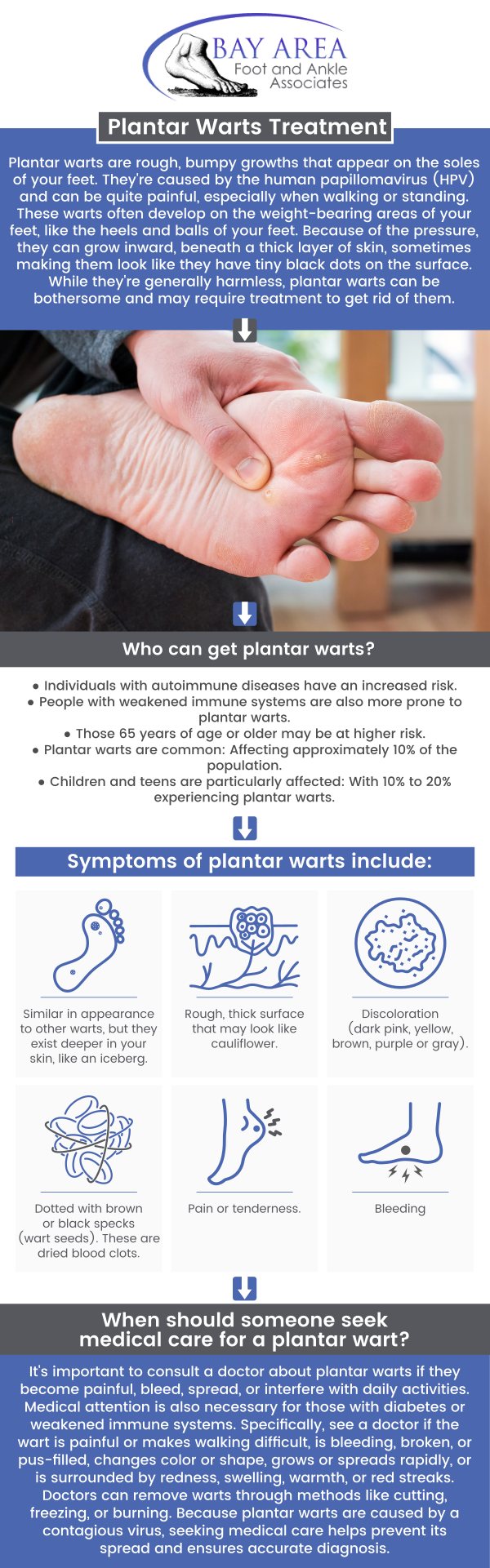
Table of Contents:
Do all plantar warts have black dots, or can you have a wart without them?
Why do the black dots in a plantar wart bleed so easily if scraped?
Do the black dots mean the wart has deep roots in my foot?
Are the black dots contagious to other people in my household?
What Treatments Do Dr. John Scivally and Dr. Robin Lie Use to Completely Remove Plantar Warts?
At Bay Area Foot and Ankle Associates, we often see patients concerned about unusual growths on the bottom of their feet, particularly plantar warts. A common misconception is that all plantar warts must have visible black dots—sometimes called “wart seeds.” These black dots are actually tiny clotted blood vessels and, while frequently present, are not always visible. Their absence does not rule out the possibility of a plantar wart.
Plantar warts can appear without these black dots, especially in early stages or if the wart has been worn down by walking or shaving. The more reliable signs to look for include a rough, grainy surface and a growth that disrupts the normal lines of your skin.
If you suspect you have a wart on your foot—even if you don’t see black dots—it’s important to have it evaluated by a foot specialist. Our experienced podiatrists at Bay Area Foot and Ankle Associates can provide a thorough examination, confirm the diagnosis, and discuss the most effective treatment options to relieve your discomfort and prevent the spread of warts.
At Bay Area Foot and Ankle Associates, we frequently see patients concerned about black dots in the center of painful growths on the soles of their feet. These black dots, commonly seen in plantar warts, are often mistaken for seeds. In reality, they are tiny clotted blood vessels that result from the human papillomavirus (HPV) infecting the skin on the bottom of the foot.
Plantar warts develop as the virus stimulates extra skin tissue to grow. As the wart is pressed into the foot by walking or standing, it puts pressure on the small blood vessels within the area. This pressure can cause the vessels to become engorged or break, which leads to the appearance of the classic black dots—small areas of dried, clotted blood.
When plantar warts are scraped, either accidentally or during attempts at self-removal, the surface layer is removed and these fragile blood vessels are exposed. Since these vessels are close to the surface and have been altered by the wart’s growth, they can bleed easily with even minimal trauma. While this bleeding is not dangerous, it is a distinguishing feature of plantar warts and helps us differentiate them from other common foot conditions, such as calluses or corns, which lack these blood vessels.
Proper care is essential when treating or removing plantar warts to prevent unnecessary bleeding and lower the risk of infection. At Bay Area Foot and Ankle Associates, we recommend that if you notice persistent bleeding, pain, or discomfort from a wart, you schedule an appointment with one of our specialists. Our team can provide expert evaluation and a range of safe, effective treatment options to help you get back on your feet comfortably.
At Bay Area Foot and Ankle Associates, we often see patients who are concerned about the appearance of black dots in warts on their feet. It’s a common misconception that these black dots mean the wart has “deep roots.” In reality, warts do not have roots like plants. The black dots you notice are actually tiny blood vessels that have clotted or sealed after being brought to the surface by the human papillomavirus (HPV), the virus responsible for causing warts. These are sometimes called “seed warts,” but this term can be misleading—the virus only affects the top layer of your skin, and the wart tissue grows outward, not deeper into your foot.
The presence of black dots is a common and normal feature of plantar warts and does not mean the wart is more severe or harder to treat. However, if you are experiencing pain, notice your wart spreading, or if over-the-counter treatments have not been effective, we encourage you to schedule an appointment with Bay Area Foot and Ankle Associates. Our experienced podiatrists can provide a proper diagnosis and recommend the most effective treatment options to help you get back on your feet comfortably and confidently.
At Bay Area Foot and Ankle Associates, we often see patients who are concerned about black dots appearing on their feet or ankles. It’s natural to wonder if these spots might be contagious, especially if you live with others. The answer depends on what’s causing these black dots.
Common Causes of Black Dots on Feet and Ankles
• Plantar Warts: One of the most frequent causes of black dots on the feet is plantar warts, which are caused by the human papillomavirus (HPV). These warts often appear as rough, grainy growths with tiny black dots (actually small, clotted blood vessels). Plantar warts are contagious and can spread through direct contact or by sharing surfaces like showers or towels.
• Fungal Infections: Conditions like an athlete’s foot can sometimes cause dark spots or discoloration. Fungal infections thrive in moist environments and can be spread through shared floors, shoes, or socks.
• Blackheads and Clogged Pores: While less common on the feet than the face, clogged pores or blackheads can sometimes appear. These are not contagious and result from oil and dead skin cells blocking the pores.
• Other Causes: Trauma, bruising, or underlying medical conditions may also cause black spots. These are typically not contagious.
If you notice black dots on your feet or ankles—especially if they are painful, spreading, or changing in appearance—it’s important to get a professional evaluation. Some causes, like plantar warts and fungal infections, can spread to others if not treated promptly.
At Bay Area Foot and Ankle Associates, Dr. John Scivally and Dr. Robin Lie are dedicated to providing advanced and effective treatments for plantar warts—stubborn growths on the soles of the feet caused by the human papillomavirus (HPV). Our approach begins with a comprehensive evaluation to confirm your diagnosis and assess the size, depth, and resistance of the wart to any previous treatments.
For especially stubborn or deeply rooted plantar warts, our team may suggest laser therapy, which uses focused light energy to remove wart tissue and eliminate the underlying virus. In some cases, minor surgical excision under local anesthesia can be performed to precisely remove the wart while preserving healthy surrounding skin.
Throughout your treatment at Bay Area Foot and Ankle Associates, we prioritize patient education, proper wound care, and regular follow-up visits to ensure optimal healing and complete eradication of the wart. Our comprehensive, personalized treatment plans are designed to deliver the highest success rates while minimizing discomfort and reducing the risk of recurrence—helping you get back on your feet, pain-free. For more information, contact us or request an appointment online. We are located at 2400 Balfour Road, Suite 230 Brentwood, CA 94513. We serve patients from Brentwood CA, Pittsburg CA, Antioch CA, Discovery Bay CA, Byron CA, Oakley CA, Knightsen, CA, and surrounding areas.
Check Out Our 5 Star Reviews


Additional Services You May Need
▸Custom Foot Orthotics
▸Ingrown Toenail Specialist
▸Traditional Podiatry Care
▸Foot and Ankle Surgery Clinic
▸Bunion Doctor
▸Corns and Calluses
▸Foot Arthritis and Joint
▸Warts
▸Video Gait Analysis
▸Athletic Taping
▸Pediatric Foot Specialist
▸Gait Abnormalities
▸Foot Dermatologist
▸Foot Deformities
▸Chronic Foot Injury
▸Diabetic Foot Specialist
▸Acute Foot Injuries
▸Podiatric Sports Services
▸Plantar Fasciitis Specialists



 Send Text
 How May I Help You?